Why Whole Human Leadership begins with you.
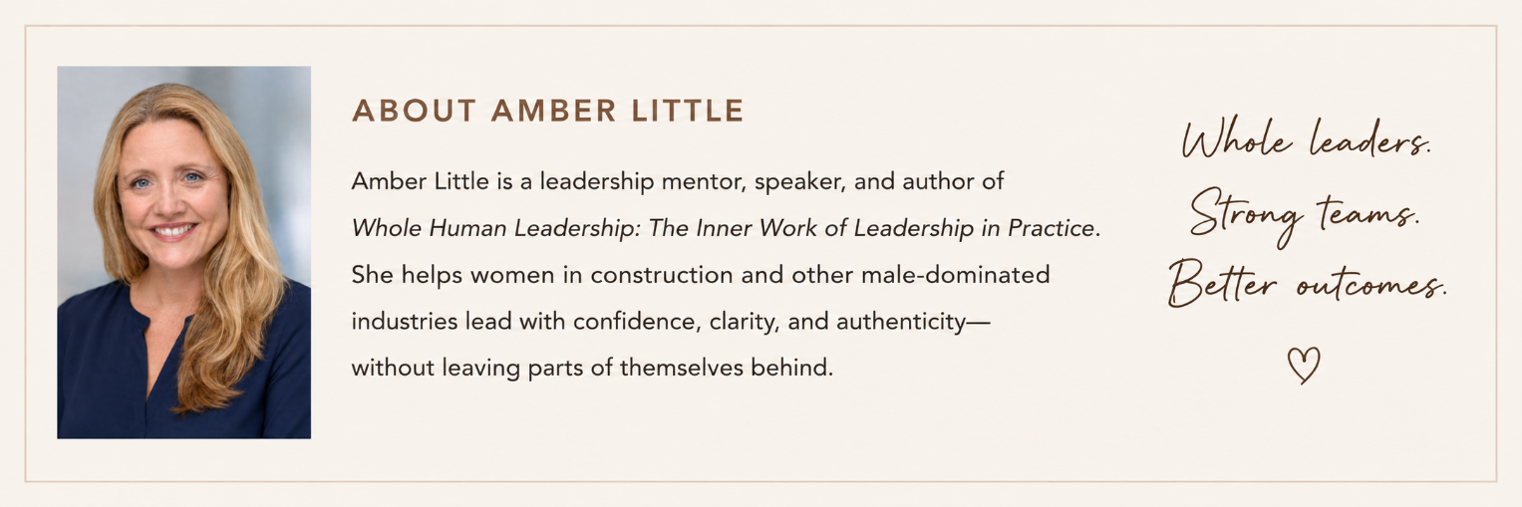
By Amber Little
You Are Part of the Equation, Too

We’ve all heard the airplane safety instruction: Put on your own oxygen mask before helping the person beside you.
The reason is simple. If you lose your ability to function, you can’t effectively help someone else.
Leadership works the same way.
We spend so much time asking ourselves what people need from us. What does my team need from me? What do my employees need from me? What do my kids need from me? What does my family need from me? What does this situation need from me?
We focus so much on what everyone else needs from us; clarity, direction, encouragement, accountability, patience, resilience; that we forget to ask whether we are actually in a place to give those things well. We become really good at figuring out what everyone else needs while rarely stopping long enough to ask what we need.
And I promise you, you are not alone.
When You’re Used to Proving You Belong
For women building careers in traditionally male-dominated industries, there can be another layer to this. Sometimes, before we ever think about leading, we are simply trying to prove we belong in the room.
We learn the business. We prepare. We work hard. We become dependable. We make sure we know what we’re talking about before we speak. Sometimes we overprepare because we know our mistakes may be remembered longer. Sometimes we hesitate to speak because we don’t want to be perceived as difficult, emotional, or overly aggressive. Sometimes we watch an idea get overlooked when we say it and embraced when someone else does.
And sometimes we become so focused on proving that we can handle everything that we stop asking whether we should have to.
That can become its own kind of armor: I can handle it. I’ll figure it out. I don’t need help. I’ll take care of it.
Those sentences sound a whole lot like strength. Sometimes they are. But sometimes they are also the reason we are exhausted.
Just because you can carry something doesn’t mean you are supposed to carry all of it.
The Quiet Ways We Lose Our Voice
Women don’t wake up one morning and decide to make themselves smaller. It happens much more quietly than that.
We don’t ask the question because everyone else seems to understand. We soften an opinion we actually feel strongly about. We start a sentence with, “This might be a stupid idea, but…” We don’t apply for the job because we don’t check every box. We stay quiet in the meeting and then have the conversation in our head on the drive home. We tell ourselves we’ll speak up next time.
All the while, the people around us may see an accomplished, capable woman. They have no idea how often she is questioning herself.
That’s one of the things I’ve learned about confidence: it doesn’t always come first.
Sometimes we think we need to become confident enough before we use our voice. But often, using our voice is how we build confidence. We speak before we are completely comfortable. We ask the question. We offer the idea. We respectfully disagree. We advocate for ourselves.
Every time we do, we collect a little more evidence that maybe we belong there after all.
And Then There’s Home

For working mothers, the equation gets even more complicated. At work, we may feel pressure to prove that being a mother hasn’t made us less committed. At home, we may wonder whether being committed to our career makes us less present.
So we keep asking ourselves the same question in different forms: Am I doing enough?
Enough for my team? My company? My kids? My spouse? At home? At work?
It’s a question with no finish line. There will always be another email we could answer, another project we could take on, another practice we could attend, another dinner we could cook, another person we could help.
Which is why, eventually, we have to start asking a different question:
Where am I in all of this?
Not because everyone else’s needs stop mattering. They don’t. But because we begin to understand something that should have been obvious all along:
I am part of the equation too.
Leadership Isn’t Separate From the Rest of Your Life
For years, I thought about leadership primarily in terms of what I gave other people. How well did I communicate? Did I develop my team? Did I support my people? Did I give feedback? Did I create opportunities? Was I showing up in the way others needed me to?
Those things still matter deeply to me. But my definition of leadership has gotten bigger.
Because we don’t leave pieces of ourselves in the parking lot when we walk into work.
There isn’t a professional version of us over here and a completely separate “real” person somewhere else. The woman who walks into the meeting may also be carrying what happened at home that morning. She has relationships, fears, ambitions, disappointments, responsibilities, insecurities, and dreams. She has seasons when she feels strong and seasons when she is figuring it out as she goes.
She is a whole human being.
And I’ve come to believe that understanding that person is part of becoming the leader we want to be. Taking care of the person behind the leader isn’t separate from leadership development. It is leadership development.
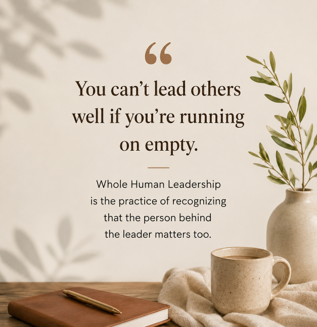
You can’t consistently give calm when you are running on empty. You can’t create psychological safety if you haven’t examined your own reactions. You can’t encourage someone else to have boundaries while ignoring your own. You can’t sustainably lead everyone around you while treating yourself as an afterthought.
That doesn’t mean a leader has to have everything figured out before they can lead. None of us would qualify.
It means recognizing that you are part of the leadership equation too.
That is what Whole Human Leadership has come to mean to me.
It is not choosing between being a good leader and being a whole person. It is not choosing between ambition and family. It is not abandoning our responsibilities in the name of “choosing ourselves.”
It means refusing to erase ourselves while fulfilling all of the roles we care about.
I Don’t Have All the Answers
This part matters.
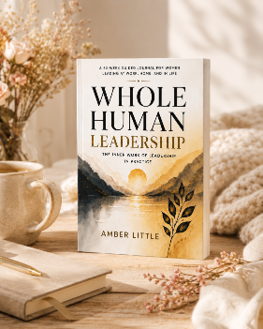
I didn’t write Whole Human Leadership because I’ve figured all of this out. I haven’t.
I’ve simply lived through enough seasons to have collected some experiences. I’ve been a leader, a working mom, a wife, and a woman building a career. I’ve experienced success and disappointment, relationships and change, mistakes and reinvention. I’ve had seasons when I felt incredibly clear about where I was going and others when I had to question things I once thought I knew.
My experiences don’t make my answers right for someone else. Your circumstances may look completely different from mine. Your priorities may be different. Your definition of success may be different.
And that’s exactly the point.
My answer doesn’t have to be your answer.
But maybe the questions I’ve had to ask myself can help you find yours.
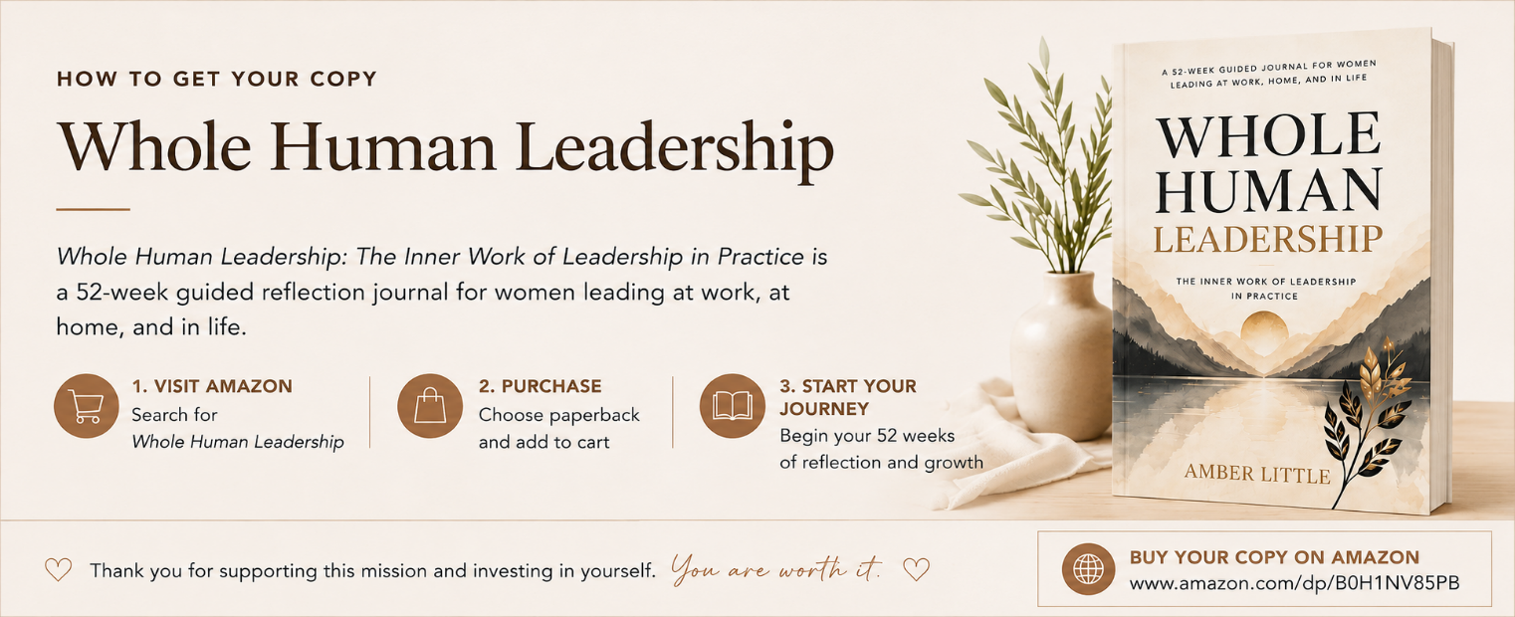
That is why I created Whole Human Leadership as a guided reflection journal instead of simply writing another leadership book. I didn’t want women to just read it. I wanted them to use it.
To stop and think. To challenge some of the stories they have been telling themselves. To recognize where they’ve grown. To decide what they want to carry forward and what they may finally be ready to put down.
Because sometimes the most important leadership work isn’t visible to anyone else. It happens quietly, when we’re willing to get honest with ourselves.
So maybe start here:
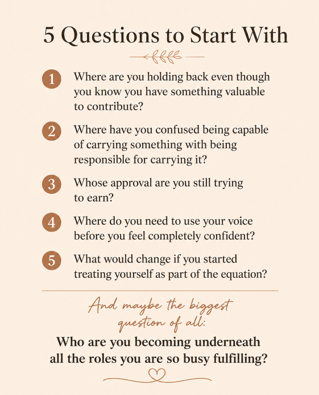
· Where are you holding back even though you know you have something valuable to contribute?
· Where have you confused being capable of carrying something with being responsible for carrying it?
· Whose approval are you still trying to earn?
· Where do you need to use your voice before you feel completely confident?
· What would change if you started treating yourself as part of the equation?
And maybe the biggest question of all:
Who are you becoming underneath all the roles you are so busy fulfilling?
You don’t have to have the answer today. But you are worth asking the question.